



















Stack Rush
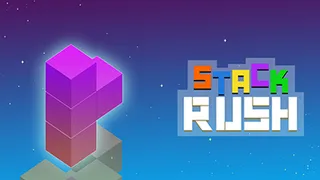
Stack Rush evolves the block-placement genre by mapping the grid onto a cylindrical coordinate system. Players must manage spatial inventory on a rotating control plane, demanding high APM (actions per minute) and rapid pattern recognition in 360 degrees.
What is Stack Rush
Stack Rush is a 3D tile-matching puzzle game played on a radial grid. Unlike Cartesian-based stackers (like Tetris), the playfield is a circular platform that the player rotates relative to a fixed drop vector. The objective is to maximize volumetric efficiency: filling a complete radial layer (“ring”) causes it to effectively despawn, converting potential energy into score points and reclaiming vertical headroom. Failure occurs when the stack height intersects the generation ceiling.
How to Play Stack Rush
The core loop requires managing two axes: Rotational Alignment and Vertical Velocity. Incoming polyominoes descend at a fixed terminal velocity (which accelerates over time). The player must rotate the base cylinder to align empty voxel slots with the descending block’s footprint.
The game challenges spatial reasoning by forcing players to visualize the “back” of the stack. Since the view is isometric/3D, successful players must maintain a mental map of the occluded side of the cylinder to execute blind spins for optimal placement.
Game Controls
| Action | PC Controls |
|---|---|
| Negative Rotation (CCW) | Left Arrow / A |
| Positive Rotation (CW) | Right Arrow / D |
Tips and Tricks
The Flat-Top Protocol
Problem: uneven surface topology (“spires”) creates unusable voids.
Solution: Prioritize placement that minimizes variance in z-axis height. A flat surface maximizes the probability that the next random piece will be playable without creating gaps.
Look-Ahead Buffer
Problem: Reaction time decreases as drop speed increases.
Solution: Focus vision on the spawn point, not the landing zone. Use the travel time to pre-calculate the shortest rotation path (CW vs CCW) to the target slot.
Peripheral Management
Problem: Tunnel vision on the front-facing blocks.
Solution: Constantly rotate the stack during “idle” moments between drops to refresh your mental model of the rear-side topology.
More Games Like Stack Rush
- Helix Jump: Inverts the mechanic—rotating to avoid collision rather than to seek collision.
Frequently Asked Questions
Is Stack Rush endless?
Yes. The game operates on an infinite-runner logic loop. The difficulty scales indefinitely until the player fails to clear lines fast enough to counter the drop rate.
does block rotation exist?
No. Unlike Tetris, you cannot rotate the individual falling blocks. You can only rotate the world (the receiver platform) to accommodate the block’s fixed orientation. This shifts the cognitive load from object manipulation to environmental manipulation.